|
3 liter non CO2
|
| Plantbrain |
Posted on 11.12.2009 03:05
|

član
Posts: 88
Joined: 10.12.2009
|
this is on the other extreme, a 3 liter aquarium with Clown Killifish and Cherry shrimp, no CO2, no Excel, no water changes(9-12 months between any water changes, water added for evaporation only).
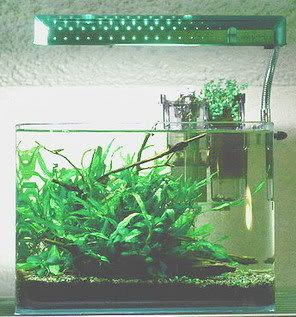
Simple but easy to care for and fish and shrimps both bred.
Regards,
Tom Barr |
| |
|
|
| biobiofizicar |
Posted on 11.12.2009 05:32
|

Administrator
Posts: 4180
Joined: 20.03.2009
|
Thanks for sharing this tank with us.
So, it can be done. No maintenance - just a joy. (on scientific bases (on scientific bases  ) )
Personally, I like small tanks. They are good playgrounds and places for quick checking some ideas. It is much easier to fill it with hardscape and plants and if they do not need special care - even better!!! (not to mention lack of space in my flat  ) )
In a near future I will try to run such a low maintenance small tank - just for experiment and to have a peace of nature at my office desk
|
| |
|
|
| paleoglodit |
Posted on 12.12.2009 17:31
|
član
Posts: 2228
Joined: 10.03.2009
|
But You didn't tell us about substrate. |
| |
|
|
| Plantbrain |
Posted on 15.12.2009 05:45
|
član
Posts: 88
Joined: 10.12.2009
|
paleoglodit je napisao:
But You didn't tell us about substrate.
It's just SeaChem Onxy sand, you could use dolomite white sand etc, which would give a similar effect but different color.
The dosing is done 2-4x a month.
A small amount, roughly 1/10th or a little less of EI dosing.
It's a version of a non CO2 planted Aquarium without using soil.
Using soil + water column is wiser than one or the other, no matter if you use a non CO2 or a CO2 gas enriched method.
Many use just one method location for nutrients or the other, using both locations removes the trade offs of each method while keeping the good parts.
Not a bad deal.
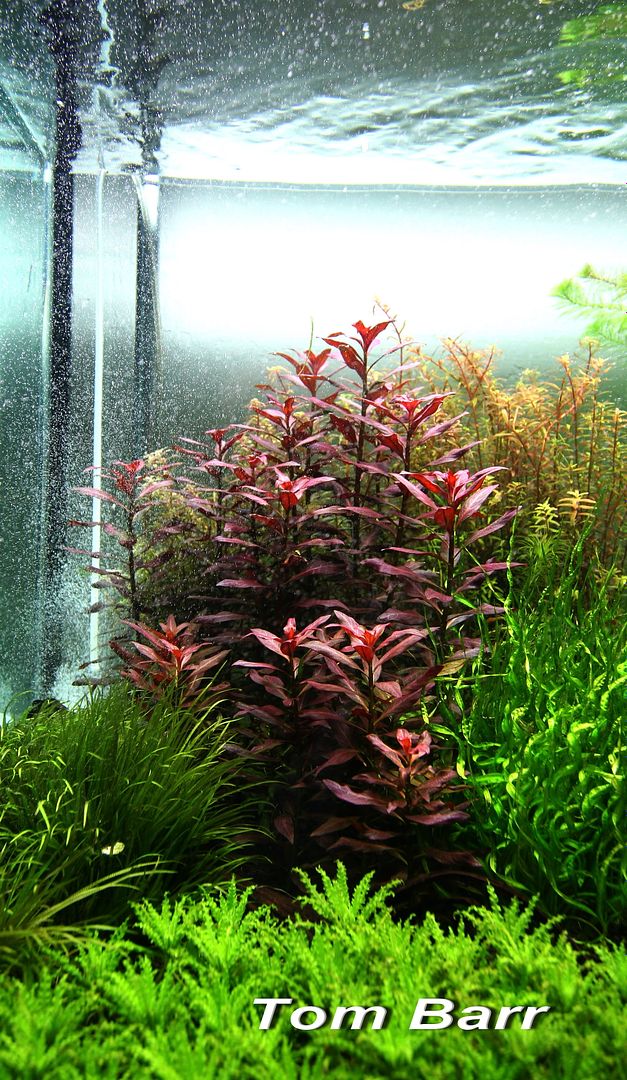
Here's an example with CO2+ water column rich and sediment rich nutrients:
Regards,
Tom Barr |
| |
|
|
| kojot |
Posted on 15.12.2009 07:57
|

Moderator
Posts: 1636
Joined: 14.03.2009
|
Tom can you tell me which plant is growing emersed in hang on filterč
First pic. |
| |
|
|
| biobiofizicar |
Posted on 15.12.2009 10:02
|
Administrator
Posts: 4180
Joined: 20.03.2009
|
From Seachem product description:
Onyx Sand™ is a specially fracted, stable porous clay gravel for the natural planted aquarium. Its appearance is best suited to planted aquaria, but may be used in any aquarium environment. Being carbonate rich, Onyx Sand™ provides an advantage to any plants able to utilize bicarbonates
Does it mean that the choice of plants for such aquarium is only bicarbonate utilizing plantsč
If I understand correctly, the most of algae are good bicarbonate users. What is stopping them to bloom on such gravelč
|
| |
|
|
| Plantbrain |
Posted on 15.12.2009 11:43
|
član
Posts: 88
Joined: 10.12.2009
|
kojot je napisao:
Tom can you tell me which plant is growing emersed in hang on filterč
First pic.
Good old HC, Hemianthus callicoides
Grows on my wood in other tanks emergently.
Regards,
Tom Barr |
| |
|
|
| Plantbrain |
Posted on 15.12.2009 11:46
|
član
Posts: 88
Joined: 10.12.2009
|
biobiofizicar je napisao:
From Seachem product description:
Onyx Sand™ is a specially fracted, stable porous clay gravel for the natural planted aquarium. Its appearance is best suited to planted aquaria, but may be used in any aquarium environment. Being carbonate rich, Onyx Sand™ provides an advantage to any plants able to utilize bicarbonates
Does it mean that the choice of plants for such aquarium is only bicarbonate utilizing plantsč
If I understand correctly, the most of algae are good bicarbonate users. What is stopping them to bloom on such gravelč
No, but adds a little and then there's some Ca, Mg in dolomite.
Not that it dissolves quickly, it's a rather slow long process.
So the rate of addition is also correspondingly, slow.
But growth is also slow.
There are many species that do not use bicarbonate that will grow fairly well in a non CO2 aquarium. Hygro difformis is one species.
Regards,
Tom Barr |
| |
|
|
| paleoglodit |
Posted on 15.12.2009 17:18
|
član
Posts: 2228
Joined: 10.03.2009
|
May you tell us what is the maximum light for non-CO2 tanks. |
| |
|
|
| Plantbrain |
Posted on 15.12.2009 20:51
|
član
Posts: 88
Joined: 10.12.2009
|
paleoglodit je napisao:
May you tell us what is the maximum light for non-CO2 tanks.
I do not know. The min is likely around 20-30micromols for some species.
The max light would depend on many other factors, how long and how much biomass is there, what species etc.
Regards,
Tom Barr |
| |
|